

05 — Software & platforms
Build what your business needs next.
Sometimes the tool you need does not exist yet. We take that carefully — discovery and a prototype first, so the commitment grows with the certainty.
Who this is for
- Selective software and product founders with a defined first problem
- Operations teams outgrowing spreadsheets and generic tools
- Businesses needing a portal or dashboard their customers actually use
What you get
Deliverables, stated plainly.
Discovery and requirements
The problem, the constraints, and what the first version must do.
Prototype and interface design
Something to react to before significant build cost is committed.
Web applications, portals and dashboards
Built for the people who will use them every day.
Backend and integrations
Data models, permissions and connections to the systems you rely on.
QA, release and handover
Testing against acceptance criteria, release, and documented handover.
Concept showcase
An illustration of the thinking.
A studio concept made for this site. It is an illustrative exploration — not commissioned client work, and not a live product.
Internal portal — first version
Illustration only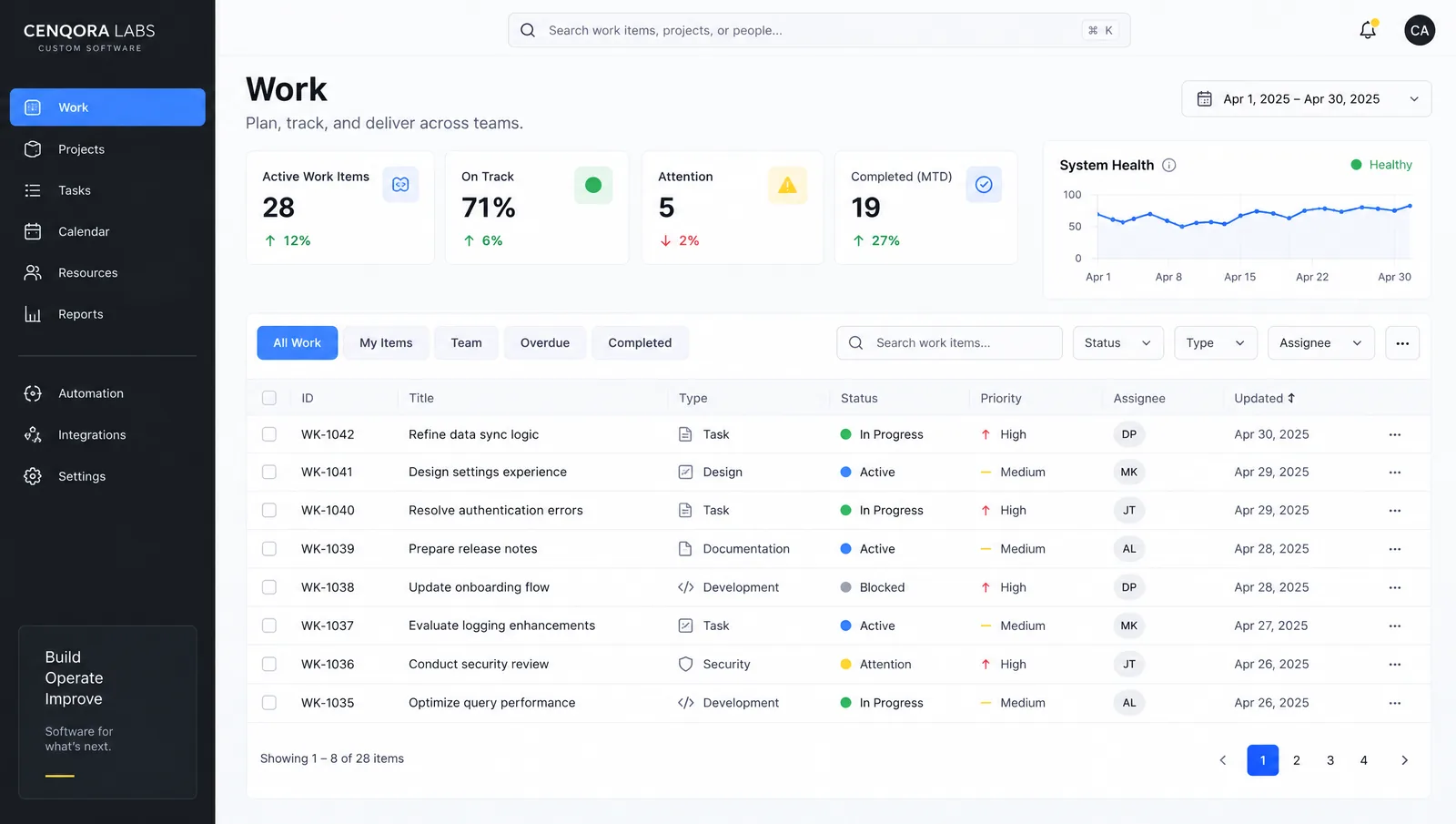
Stages
01
Discover
Problem, users, constraints and integration reality.
02
Define
Scope of a first version and its acceptance criteria.
03
Build
Prototype, then build, test and review in stages.
04
Evolve
Release, handover, then optional ongoing support.
Scope and boundaries
- Engagements are staged — discovery and prototype come before full build commitment.
- Acceptance criteria are written and agreed before build.
- Integration constraints are assessed before anything is promised.
- Ongoing support and hosting arrangements are optional and agreed separately.
Useful to know
Questions worth asking early.
- Can we start small?
That is the recommended route: a discovery and prototype stage first. It is a smaller commitment, and it gives both sides something concrete before the larger decision.
- Will it connect to the systems we already run?
We check that before it becomes a promise. Integration depends on the access and interfaces a platform actually offers, so it is assessed during discovery and written into scope.
- Who owns the result?
Ownership, licensing and support are set out per engagement in writing before build starts, so there is nothing ambiguous at handover.
Tell us what you would like to improve.
The enquiry form arrives with software & platforms already selected. You can change it at any point.
