

02 — Business automation
Make your operations flow.
Manual handoffs quietly cost teams their best hours. We map how work actually moves, then remove the friction one workflow at a time.
Who this is for
- Growing companies with manual handoffs between tools and people
- Teams re-entering the same information in more than one place
- Operations leads who need visibility rather than more spreadsheets
What you get
Deliverables, stated plainly.
Process mapping
How work moves today, where it waits, and where it is being done twice.
CRM and tool integrations
Connecting the systems you already pay for so information stops being retyped.
Intake, routing and approval flows
A clear front door for requests, with routing and approval that matches real responsibility.
Dashboards and reporting
A view of status and volume that answers the questions your team keeps asking.
Exception handling and documentation
What happens when something fails, who is notified, and written steps for your team.
Concept showcase
An illustration of the thinking.
A studio concept made for this site. It is an illustrative exploration — not commissioned client work, and not a live product.
Operations view — one queue
Illustration only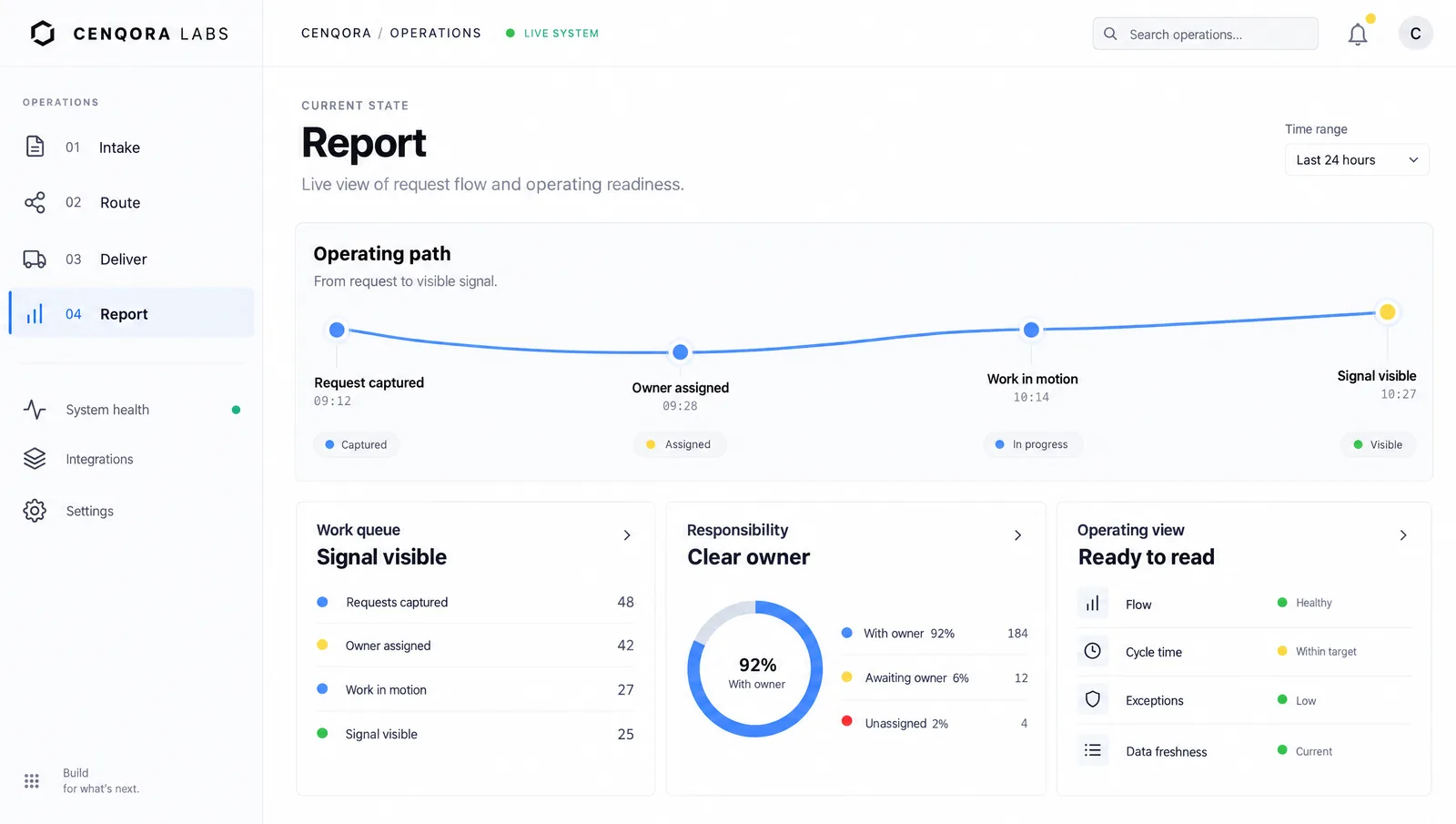
Stages
01
Discover
Walk the workflow with the people who run it.
02
Define
Choose one workflow, agree the measures, confirm tool constraints.
03
Build
Implement, test with real cases, review with the team.
04
Evolve
Verify it holds, then expand to the next workflow.
Scope and boundaries
- Existing tools are assessed before any replacement is proposed.
- We start with one defined workflow, verify it in use, then expand.
- Ongoing maintenance is arranged separately from the build.
- Platform subscription and usage costs remain yours and are agreed up front.
Useful to know
Questions worth asking early.
- Will we have to replace the tools we already use?
Not by default. We assess what you have first. Replacement is only proposed when the current tool genuinely blocks the outcome, and we explain the trade-off before anything changes.
- How small can a first project be?
One workflow. That is deliberate — a single defined flow can be built, verified and trusted quickly, and it tells us far more than a large plan would.
- What happens when an automation fails?
Failure handling is part of the build: what is retried, what is flagged, who is told, and the manual fallback. It is documented at handover rather than discovered later.
Tell us what you would like to improve.
The enquiry form arrives with business automation already selected. You can change it at any point.
